
How Long Should a Meta Video Ad Be? A Video Ad Strategy by Funnel Stage
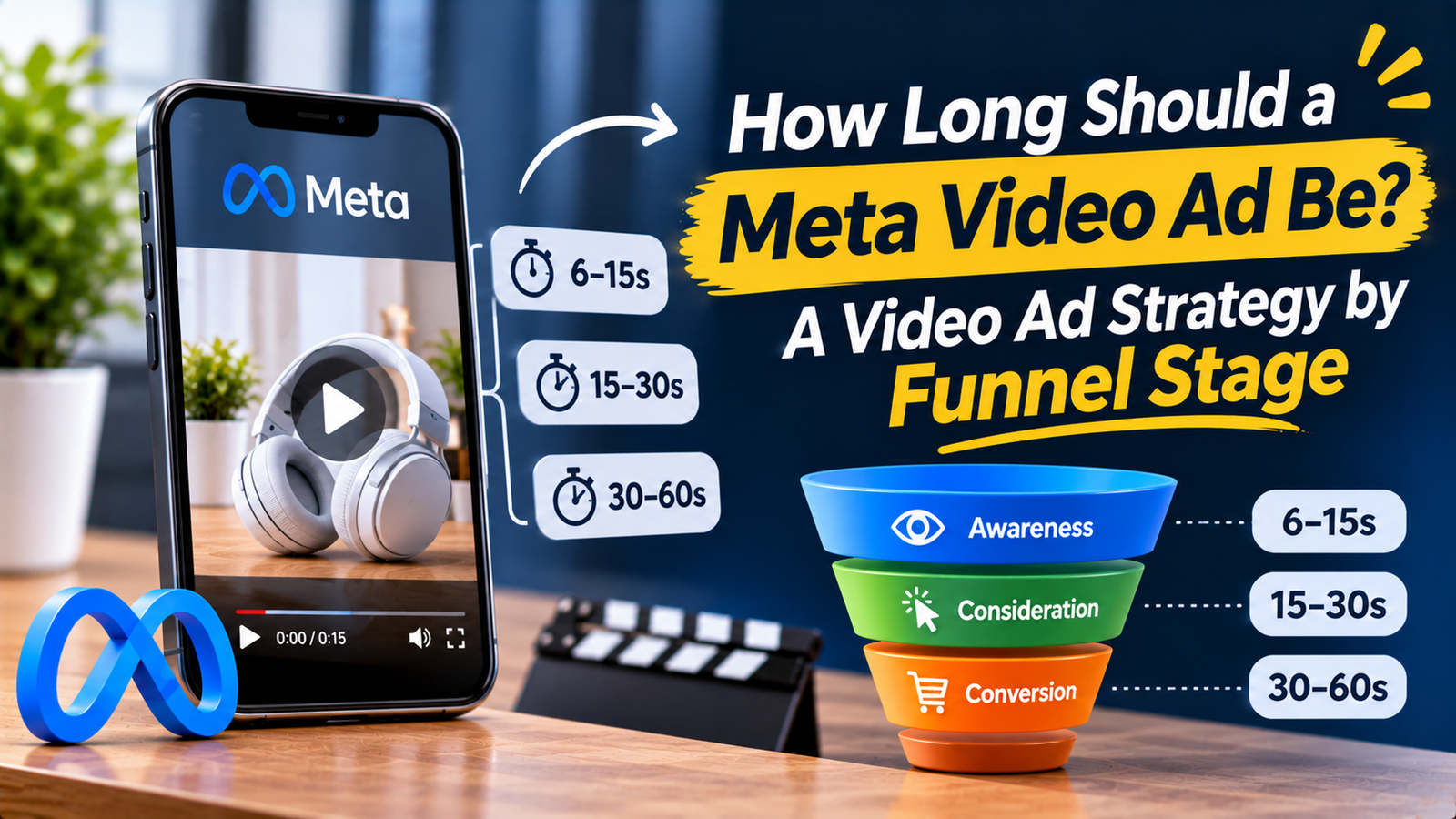
A sound video ad strategy answers a question many advertisers skip: how long should each video actually be? Length affects who keeps watching, what you can explain and how much each view costs, yet it is often decided by whatever the editor delivers. The result is a mix of 12-second clips and two-minute stories, with no idea which length suits which audience.
There is no universal best length, because the right answer depends on what the viewer already knows, where the ad appears and how much you have to say. This guide shows how to choose lengths by funnel stage and placement, how to structure a video so every second earns its place, and how to test lengths so the decision comes from your own data.
Does Video Length Really Affect Meta Ad Performance?
Yes, but not in the way most people assume. Length changes how much you can explain, how viewers behave in different placements and how the retention curve of your video looks. What matters is not the number of seconds but whether each second gives the viewer a reason to keep watching.
What Length Actually Changes
Length shapes three things. First, it limits the message: a ten-second video can introduce one idea, while a minute can show a problem, a demonstration and proof. Second, it changes viewer behavior, because people watching in a fast-scrolling vertical placement are less patient than people in a feed. Third, it influences cost and delivery, since the way people watch affects how the platform measures and serves the ad.
Why "Shorter Is Always Better" Is a Myth
Short videos are easier to finish, but they can't always carry the proof a cautious buyer needs. A tightly edited 45-second testimonial can outperform a rushed 15-second ad if viewers stay engaged to the end. The better rule is to make the video as long as the message needs and no longer. Judge a video by its retention and its cost per purchase, not by its running time.
How Long Should Video Ads Be at Each Funnel Stage?
The viewer's familiarity with your brand is the best guide to length. The table below gives starting points to test, not fixed rules.
|
Funnel stage |
Main goal |
Starting length to test |
Best-fit formats |
|
Cold audience |
Introduce the problem and product |
15–30 seconds |
Problem-led story, demonstration |
|
Warm audience |
Build trust and answer doubts |
30–60 seconds |
Testimonial, comparison, objection answers |
|
Retargeting |
Remind and close |
6–15 seconds |
Offer reminder, short proof clip |
Cold Audiences: One Clear Idea
People who have never heard of you need a simple message: here is a problem, here is how this product solves it, here is what to do next. Anything beyond one idea risks losing them. Keep the pace brisk, show the product early and avoid long introductions about the brand.
Warm Audiences: Room for Proof
Viewers who have visited your site or engaged before already know the basics. They need reasons to trust you, such as customer stories, comparisons and answers to common doubts. This is where longer videos earn their place, as long as each section adds new information.
Retargeting: Short Reminders
People who almost bought rarely need the whole story again. A short reminder of the offer, a quick proof clip or an answer to the most common objection is often enough. Keep it concise and make the next step obvious.
How Do Placements Change the Right Length?
Feed, Stories and Reels each reward different pacing. Full-screen vertical placements tend to favor fast openings and quick pacing, while feed placements give viewers slightly more patience. Meta updates its placement specifications and length limits from time to time, so check the current Meta Ads Guide before you finalize edits.
Design for Vertical and Sound Off
Make the ad in vertical format first, because it works across most placements. Add captions and on-screen text so the message survives without sound, since many people watch on mute. Keep key visuals and text away from the edges where interface elements can cover them.
How Do You Structure a Video So Every Second Earns Its Place?
A Simple Four-Part Structure
Most effective videos follow the same order: hook, problem or promise, proof or demonstration, and call to action. A 30-second example might look like this:
- 0–3 seconds: a hook that names the problem or shows the result.
- 3–10 seconds: one or two sentences expanding on the problem or promise.
- 10–24 seconds: a demonstration of the product or a piece of proof.
- 24–30 seconds: a clear call to action and the offer.
Strengthen the Opening
The first seconds decide how many people see the rest, which makes hook development the part of the process that most affects the length decision. If the opening loses most viewers, a shorter video won't fix it. Write several openings for each concept, and make sure each one connects directly to the section that follows.
Write Tight Scripts
Good UGC scriptwriting uses short sentences and one idea at a time. People usually speak at around 130 to 150 words per minute, so a 30-second voiceover holds roughly 65 to 75 words. Write to that limit, read the script aloud with a timer and cut filler phrases until it fits naturally. If a line doesn't help the viewer understand, trust or act, remove it.
How Do You Test Video Length Without Guessing?
Cut Versions From One Master
Creative testing is easiest when you film once and edit several lengths from the same footage, for example a 15-second, a 30-second and a 45-second version. Keep the hook, offer and call to action identical so that length is the only variable. Run them to the same audience with the same budget and give each enough spend to show a pattern.
Read the Retention Curve
Look at where viewers drop off. A steep fall in the first three seconds points to a weak opening, not a length problem. A steady decline through the middle suggests the video is too long for its content. If most viewers reach the call to action, the length probably fits. Always confirm with cost per purchase, because a video that holds attention but doesn't sell is still failing.
Record What You Learn
Keep a simple log with the concept, length, placement, retention, spend and cost per purchase. After a few rounds, you will see which lengths suit each funnel stage in your account, which is more valuable than any general benchmark.
Which Video Length Mistakes Cost the Most?
Padding a Video to Hit a Target Length
Stretching a message to reach a certain number of seconds usually adds filler that viewers feel immediately. If the idea only needs 20 seconds, finish in 20 seconds. Spend the saved time making the opening and the proof stronger.
Burying the Call to Action
Some videos spend so long on the story that the offer appears just as viewers leave. Mention the offer or next step earlier, and repeat it at the end. This protects results from viewers who drop off before the final seconds.
When Should You Get Expert Help With Video Ads?
If length tests show no clear pattern, the cause may lie elsewhere, such as the offer, the audience or the landing page. A Meta ads specialist can review account structure, tracking and creative together to see where results are being lost. Outside help works best when you can share your results log, because it shows what has already been tried.
Frequently Asked Questions About Meta Video Ad Length
What is the best length for a Meta video ad?
There is no single best length. Start with 15–30 seconds for cold audiences and test from there, since the right length depends on your audience and message.
Are 15-second video ads better than 30-second ads?
Not always. A 15-second ad is easier to finish, but a 30-second ad can carry more proof. Compare them on cost per purchase, not completion alone.
Should I use different lengths for Reels and Feed?
Often yes. Full-screen placements usually reward faster pacing, while Feed gives slightly more patience. Check the current Meta Ads Guide for placement limits.
How many video lengths should I test at once?
Two or three versions of the same concept is enough. More versions split your budget and make results harder to read.
Does a longer video cost more to run?
Not directly. Cost depends on how people respond to the ad, so a well-edited longer video can still perform efficiently.
How do I know if a video is too long?
Check the retention curve. If viewers keep dropping off steadily before the call to action, trim the content or move the offer earlier.
Final Thoughts
Video length is a strategy choice, not an accident of editing. Match the length to what the viewer already knows, design for vertical and sound-off viewing, and give every second a job. Cut versions from one master, compare them on cost per purchase and keep notes on what you learn. Over time, those notes turn a guess about length into a clear rule for each stage of your funnel.
Ready to Implement This in Your Ad Account?
Stop guessing why your Meta ads are stalling. Let's look inside your Ads Manager together and find the high-leverage growth bottlenecks.
Book 15-Minute Strategy Call →