
How Does a Performance Media Buyer Decide When to Scale a Winning Ad?
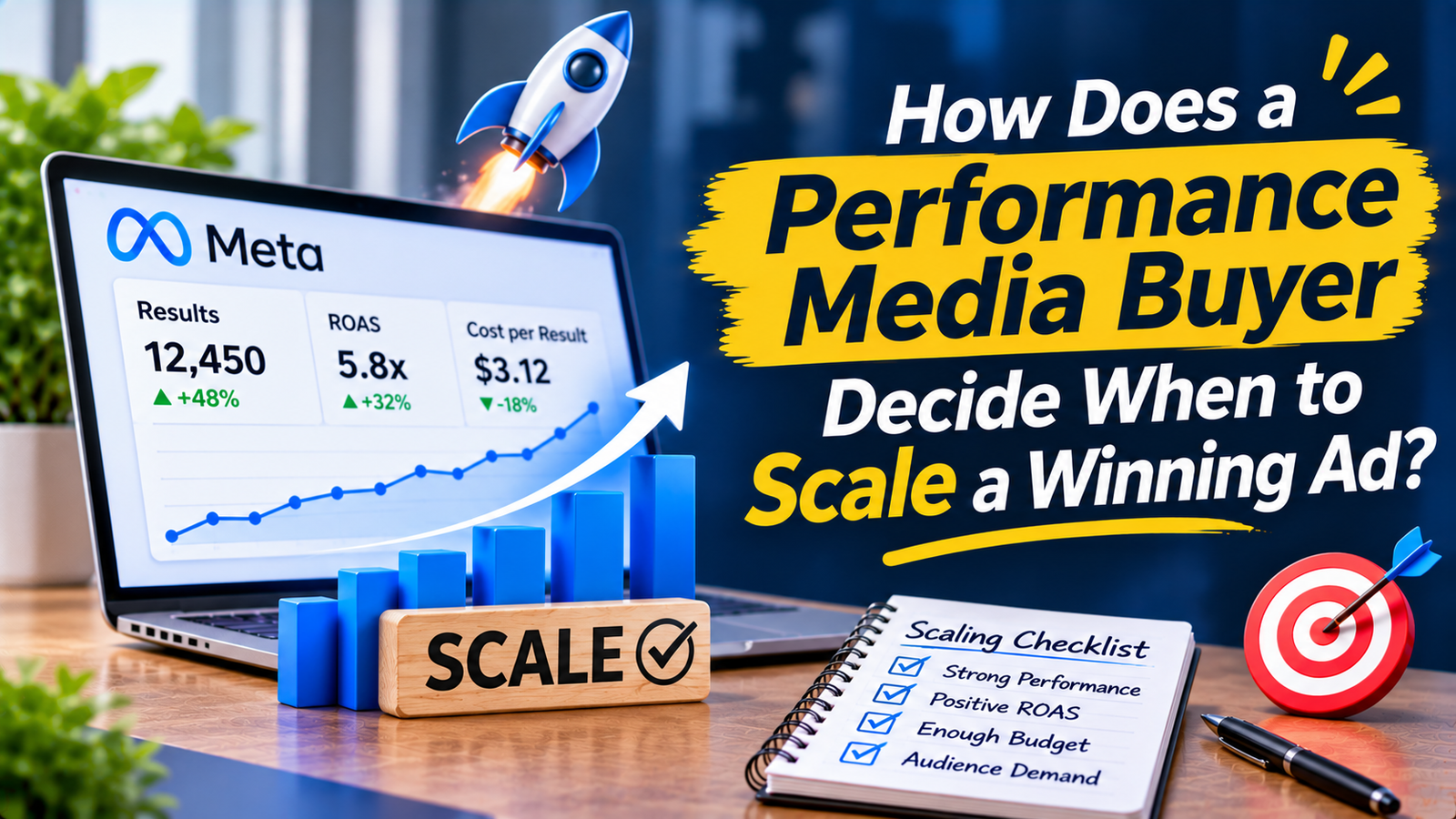
A performance media buyer spends much of the day on one deceptively hard question: is this ad truly winning, and is it safe to put more money behind it? Scale too early and a lucky week turns into an expensive mistake. Scale too late and the opportunity fades while competitors take the audience. The skill is not in raising budgets, but in knowing when the data has earned the right to be trusted.
This guide walks through the signals that show an ad is ready to scale, the budget rules that keep delivery stable and the checks that protect profit as spend grows. The examples are simplified, so adjust the numbers to your own margins and account.
What Does It Mean for an Ad to Be a "Winner"?
A winning ad is not the one with the best return in its first two days. It is the one that delivers consistent results, over enough purchases and enough time, at a cost that still leaves profit. Calling an ad a winner too quickly is the most common reason scaling goes wrong.
Why Early Results Can Mislead
Small samples swing widely. An ad with three purchases can look brilliant or terrible depending on a single order. Conversions can also arrive late, so yesterday's numbers may improve as attribution catches up. Weekdays and weekends behave differently, and a new ad often gets a short burst of novelty attention that fades. Early data is a hint, not a verdict.
The Three Tests an Ad Must Pass
Before scaling, check three things. First, volume: do you have enough purchases that the results are unlikely to be luck? Second, consistency: has the cost per purchase stayed in a reasonable range across several days? Third, profitability: does that cost leave a margin after product, shipping and other expenses? An ad that passes all three has earned more budget. An ad that passes only one needs more time.
Which Signals Show an Ad Is Ready to Scale?
No single metric makes the decision. Look at a group of signals together, and be suspicious when they disagree.
|
Signal |
Healthy sign |
Warning sign |
|
Cost per purchase |
Steady across several days |
Swings sharply day to day |
|
Frequency |
Low and stable |
Rising quickly |
|
Click-through rate |
Holding steady |
Falling week over week |
|
Site conversion rate |
Consistent with past results |
Dropping as traffic rises |
|
Purchase tracking |
Matches store orders closely |
Large gaps between platform and store |
Stable Cost Per Purchase
Stability matters more than a single low number. An ad that delivers purchases at a similar cost for five days gives you far more confidence than one with a great Monday and a poor Tuesday. Stable results suggest the ad has found an audience that responds repeatedly, not a lucky pocket.
Healthy Delivery Metrics
Frequency, CPM and click-through rate show how the audience reacts. Low frequency means most people are seeing the ad for the first time, which leaves room to grow. A steady click-through rate suggests the message still resonates. If frequency climbs while click-through falls, the ad may already be tiring, and adding budget will only speed that up.
Proof That the Offer and Page Convert
An ad can look strong while the landing page quietly loses buyers. Check that site conversion rate is steady, and confirm that purchases are tracked accurately by comparing the platform's numbers with actual store orders. Scaling on bad tracking means spending more on decisions you can't trust.
How Should You Increase Budget Without Breaking Delivery?
Once an ad has passed the tests, the next question is how fast to push. Large jumps can disrupt delivery, so most careful buyers raise spend in steps.
Increase Budgets Gradually
A common starting point is raising a budget by around 20% every few days, then watching how cost per purchase responds. If results hold, continue. If cost climbs, pause the increases and let delivery settle. Meta has said ad sets generally need around 50 optimization events in a week to exit the learning phase, so check its current guidance for your objective before making big changes.
Raise Budget or Duplicate the Ad Set?
Raising the budget on the existing ad set keeps its history and is simple to manage. Duplicating into a new ad set can sometimes find fresh delivery, but it may overlap with the original and compete against it. Neither approach is always better. Test on a small portion of spend first and compare results.
Scale Sideways Carefully
Adding new audiences, placements or countries can extend reach, but each one behaves like a new test. Treat them as separate experiments with their own tracking instead of assuming that a winning result will carry over.
How Do You Keep Scaling Profitable?
Spend can double while profit shrinks. Keeping an eye on profitability prevents the most expensive surprises.
Know Your Break-Even Numbers
Break-even ROAS equals 1 divided by your profit margin before ad spend. A product with a 40% margin breaks even at a ROAS of 2.5. Include discounts, returns and shipping costs when you calculate your margin, because ignoring them makes ads look more profitable than they are. Any scaling decision should be measured against this number.
Watch Marginal Results, Not Just Averages
As spend rises, the extra purchases tend to cost more than the early ones. An account's average cost per purchase can look fine while the latest budget increase is buying customers at a loss. Compare results before and after each increase, and stop when the added spend no longer pays for itself.
Why Does Creative Matter More as Budget Grows?
Higher budgets put the same ad in front of the same people more often, which speeds up fatigue. Scaling is therefore as much a creative problem as a budget problem.
Refresh Before Results Fall
Creative testing should run alongside scaling, ideally in a separate testing campaign, so new concepts are ready before the winner tires. When a new version proves itself, move it into the scaling campaign. Waiting until results collapse leaves you scrambling for replacements.
Rotate Static and Video
A balanced static ad strategy gives you quick-to-produce variations to rotate while longer video concepts are still in production. Static variations can test new angles, headlines and offers cheaply, and the best ideas can later become videos.
Share Results With the Creative Side
A creative strategist turns what the data says into the next round of concepts, so scaling decisions and creative decisions inform each other. Share your results log weekly so briefs reflect what the account is actually rewarding.
Which Scaling Mistakes Cost the Most?
Reacting to One Good Day
A single strong day tempts many advertisers to double the budget. Resist that urge until results hold across several days and enough purchases. Patience here protects far more money than it costs.
Changing Everything at Once
If you raise the budget, change the audience and swap the creative at the same time, you can't tell what caused the result. Change one thing at a time, and write down what you changed and when.
When Should You Bring in Outside Help?
If results fall apart every time you raise the budget, the cause may sit in the account structure, the attribution setup or the creative pipeline rather than in the ad itself. A Facebook ads expert can audit those areas and show where scaling is breaking down. Outside help works best when you can share your numbers, your break-even ROAS and a log of recent changes.
Frequently Asked Questions About Scaling Ads
How long should I wait before scaling an ad?
Long enough to see stable results across several days and enough purchases to trust the data. There is no fixed number, but one good day is never enough.
How much should I increase budget at a time?
Many advertisers use increases of around 20% every few days as a cautious starting point, then adjust based on how delivery responds.
Should I duplicate winning ads or raise the budget?
Both can work. Raising the budget is simpler, while duplicating can open new delivery. Test either approach on a small scale first.
Why does ROAS drop when I scale?
Higher spend reaches less responsive people and raises frequency, so the extra cost of each new purchase usually climbs.
What is break-even ROAS?
It is 1 divided by your profit margin before ad spend. At a 40% margin, break-even ROAS is 2.5.
How do I know when to stop scaling?
When the cost of the added purchases exceeds what your margin supports, or when fatigue pushes results down even with fresh creative.
Final Thoughts
Scaling is a series of small, evidence-based decisions, not a single big bet. Confirm that an ad is truly winning, raise the budget gradually, measure every step against your break-even numbers and keep fresh creative coming. Write down what you change so you can learn from each increase. Done this way, higher spend becomes a repeatable process instead of a gamble.
Ready to Implement This in Your Ad Account?
Stop guessing why your Meta ads are stalling. Let's look inside your Ads Manager together and find the high-leverage growth bottlenecks.
Book 15-Minute Strategy Call →